Designing Inclusive Play for Kids
What do kids learn about who they can be from the toys around them? We asked three people and 51 young adults.
- Role
- Lead researcher
- Team
- Alyssa Ramirez, Emma James, Ei Khin
- Timeline
- Summer 2026, ART 566 Research for Design, CSUN
- Status
- Complete (course project). We stopped at research directions. No product was designed or tested.
- Methods
- 3 interviews, 1 survey (51 responses), journey map, archetypes
- Tools
- Typeform, Zoom, Miro, Notion, Dovetail
A class study, not client work. ART 566 gave us a brief framed around Moose Toys, a toy company that wants to expand representation. Moose Toys was not a client, and this page does not claim they saw or used anything we found.
What we wanted to know
“More diverse toys” is a goal, and it doesn’t say how families talk about identity, what children reach for, or what parents want their kids to see. So we asked how media and play shape a child’s sense of identity, and where LGBTQIA+ representation shows up in what children watch and play.
My part: I led the research for a team of three with Emma James and Ei Khin.
was the figure in our final presentation for respondents who said the people they saw most in their toys and media were white and/or straight. The survey had 51 respondents, ages 18 to 26.

Respondents picked characters for their courage and humor. Looks came second.
From our interviews and survey.
From findings to directions
| What we found | What it means | Where it led |
|---|---|---|
| Whiteness and heteronormativity ran through the media our respondents grew up with. Finding from research | Children need a wider range of characters and families. | How might we create characters that reflect more identities, cultures and family structures? |
| Respondents named Naruto, Hermione, Katniss, Mulan and Percy Jackson. They chose characters for being funny, brave or emotionally honest, often when nobody looked like them. Finding from research | Representation has to carry values as well as appearance. | How might we help parents feel confident that a toy reflects the values they want to teach? |
| Every participant described deliberate, values-based choices about children's media. Parents prefer open-ended toys and limit early screen time. Finding from research | Toys that invite imagination and learning. | How might we design toys that encourage creativity and learning through open-ended play? |
| People who later identified as queer described going years without language for their identity. One interviewee first learned about gender identities in college. Finding from research | Age-appropriate ways to introduce identities and family structures. | How might we introduce LGBTQ+ identities and language in an age-appropriate way? |
How we did it
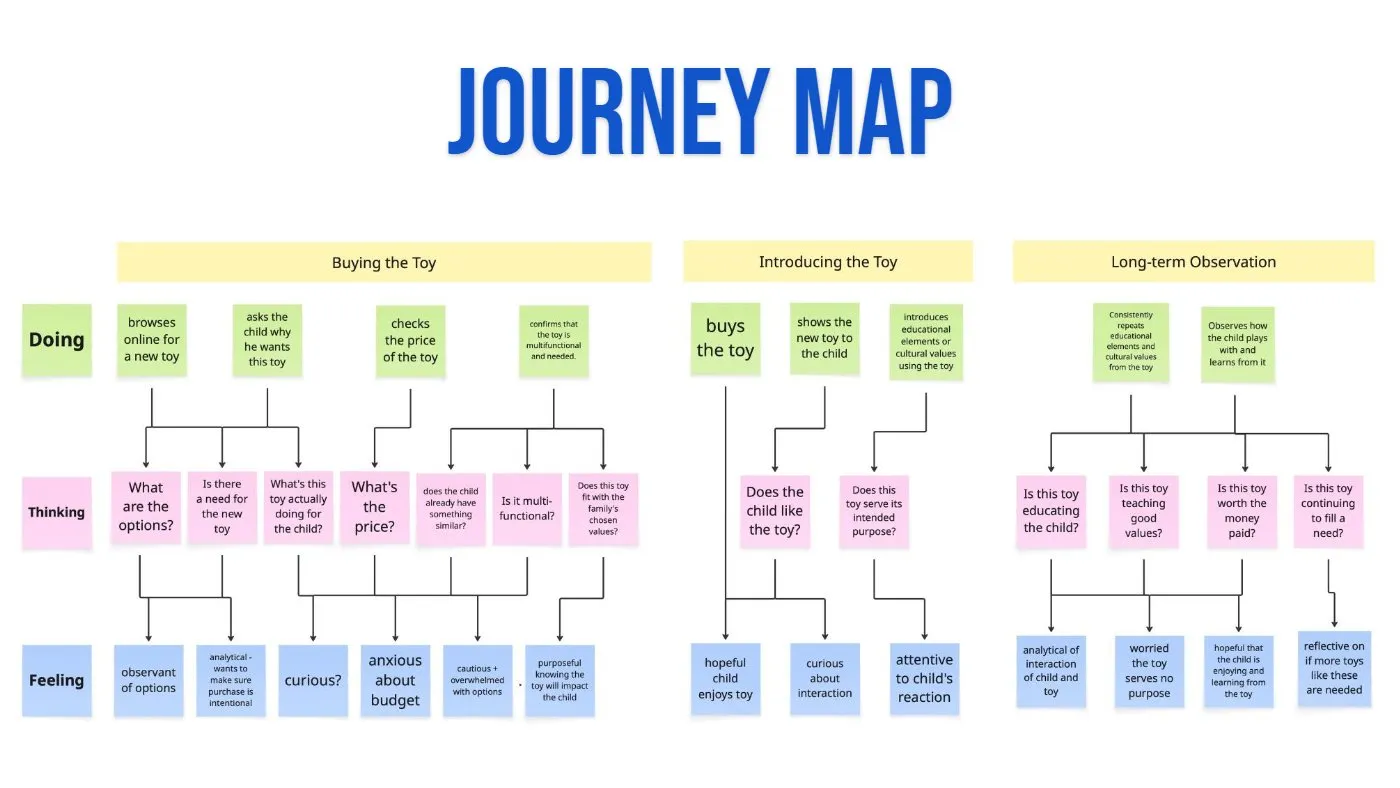
We ran two methods side by side. Interviews: three one-on-one conversations over Zoom, with two parents of children under five and one young adult, about media habits, toy choices and values. Survey: 51 young adults ages 18 to 26, collected June 20 to 24, 2026 through Typeform and shared through personal networks and social media. We worked in Miro, Notion and Dovetail.
We also sorted what we heard into three rough archetypes of how parents steer a child’s media: the Curated Kid (tight control), the Guided Kid (present and flexible) and the Free-Range Kid (few limits).
What this can’t tell you. Three interviews and a survey from our own networks is a small sample, and every parent we spoke with had a child under five. We couldn’t follow up or check our findings back with participants. Read the results as signals worth testing, not as proof about all families.
Process notes
Our four research questions
- Which kinds of media and play content do children consume that shape their understanding of diverse identities?
- How do young children develop awareness and understanding of diverse gender and sexual identities?
- How do children engage in play, and what role does play have in shaping their understanding of identity and inclusion?
- What types of media and content do young children consume, and how does that content reflect or introduce LGBTQIA+ representation?
What we’d research next
Each direction came with a next step: talk with child development professionals about age-appropriate approaches, interview more parents about the values they want to pass on, interview people from underrepresented groups, and study toys that already offer open-ended play. We’d also like to watch children play, run co-design sessions with them, and interview parents of older children.